
*Updated Feb 2026*
Hi I’m Nick Czukar. This is my scrambling and hiking blog ‘Steep Sheep’. I first launched this website in 2018 while applying for adventure guide gigs in New Zealand, somewhat in response to an HR manager asking for proof of my outdoor experience, “say in a youtube channel or blog format”. I had a handful of journal style write-ups from my early summer seasons in the Canadian Rockies, so went with the blog format and have continued with it ever since! Rather than “prove” my outdoor experiences, I use Steep Sheep for highlighting and sharing those qualitative experiences in a format designed for longer attention spans. With over a decade of peak-bagging experience, this website now offers over 70 trip reports for peaks in Banff, Yoho, Kootenay, Canmore, Golden, Rogers Pass, Invermere and New Zealand. Likely in the future you will see more areas added to that list, as the list never shortens. Currently based in Golden, British Columbia, I am regularly joined by my wife Bri for these adventurous outings and likewise joined by a handful of regular characters who enjoy a good plod!
FULL DISCLAIMER – hiking, scrambling and mountaineering are inherently dangerous activities. Many of these trips involve travel through high-risk terrain including but not limited to rockfall hazards, tripping or falling hazards, exposure to heights, exposure to seasonal elements, exposure to adverse weather, and wildlife corridors. These reports, while an honest retelling of personal experience and containing route descriptions, should not be solely relied on when heading into the back country. Always consult multiple sources before heading out, and try to focus on the most recent beta available whenever possible. While my difficulty ratings are generally consistent with other sources, they are highly subjective!
The difficulty ratings I’ve assigned are mostly based on Alan Kane’s (2016) ratings in the 3rd Edition of Scrambles. For more technical routes, I rely on the French mountaineering grades as used in Bill Corbett’s 11,000ers of the Canadian Rockies 2nd Edition (2016). I often hyphenate my scrambling ratings, for example, an “easy-moderate” implies that the route is mostly the first descriptor, easy, with some brief sections of moderate scrambling.
Mostly Hiking: As the title implies, mostly hiking involves modest or difficult hiking but no real hands-on scrambling to be expected, minimal falling/injury risk. Other risks can still be present.
Easy: Mostly still hiking, may involve some hands-on scrambling. Often involve slogging up scree slopes, rubbly talus, or broad staircase style ledges with minimal falling/injury risk though not risk-free. Possible exposure to heights or overhead rockfall hazards. While the technicalities are minimal this rating can still encompass some fairly strenuous outings, such as Willowbank Mountain near Golden. Paget Peak, The Judge and Pinto Mountain are all great examples of Easy Scrambles
Moderate: a medium difficulty and broader term that is more risky than easy. Generally, more hands-on sections, steeper aspects, more exposure to fall risk and overhead rock hazards, potential brief exposure to no-fall zones. Perhaps some route finding along the way. I often hyphenate it when assigning ratings based mostly on fall exposure. Helmets strongly recommended for these ratings, especially in the Rockies. This rating loosely correlates to Class II scrambling but also include some easier Class III routes. Eiffel Peak, Mount Niles, and Mount Noyes are all great examples of Moderate Scrambles
Moderate/Difficult: In practical terms, a made-up term I often use to describe sustained 3rd class routes. Compared to the general ‘moderate’ rating, this category is much more hands on and will sustain a moderate level of exposure. Falls would be crippling but not necessarily fatal, though no-fall zones are to expected at cruxes. The cruxes on these routes may teeter into 4th Class climbing though should not require ropes in ideal conditions. Adequate route-finding skills often needed at this difficulty level. One should be donning a helmet. Mount Ogden and Mount Sifton are good examples of this hyphenated rating.
Difficult: More sustained route-finding, sustained hands-on sections; smaller or trickier holds, sustained or high falling/injury risk; prolonged travel through fatal ‘no-fall’ zones, crux sections may involve low 5th class climbing moves. Bokor Peak’s east ridge, and Mount Vaux are both great examples of a Difficult scramble.
Climber’s Scramble: a term of increasing popularity to describe sustained 4th class routes or harder. Often more than one crux at a low 5th level. Ropes are optional for those experienced, inexperienced parties will likely want the rope for cruxes or descents. Mount Murchison’s South Summit is a prime example.
Technical or Mountaineering: use of ropes for either rock climbing and or glacier travel.
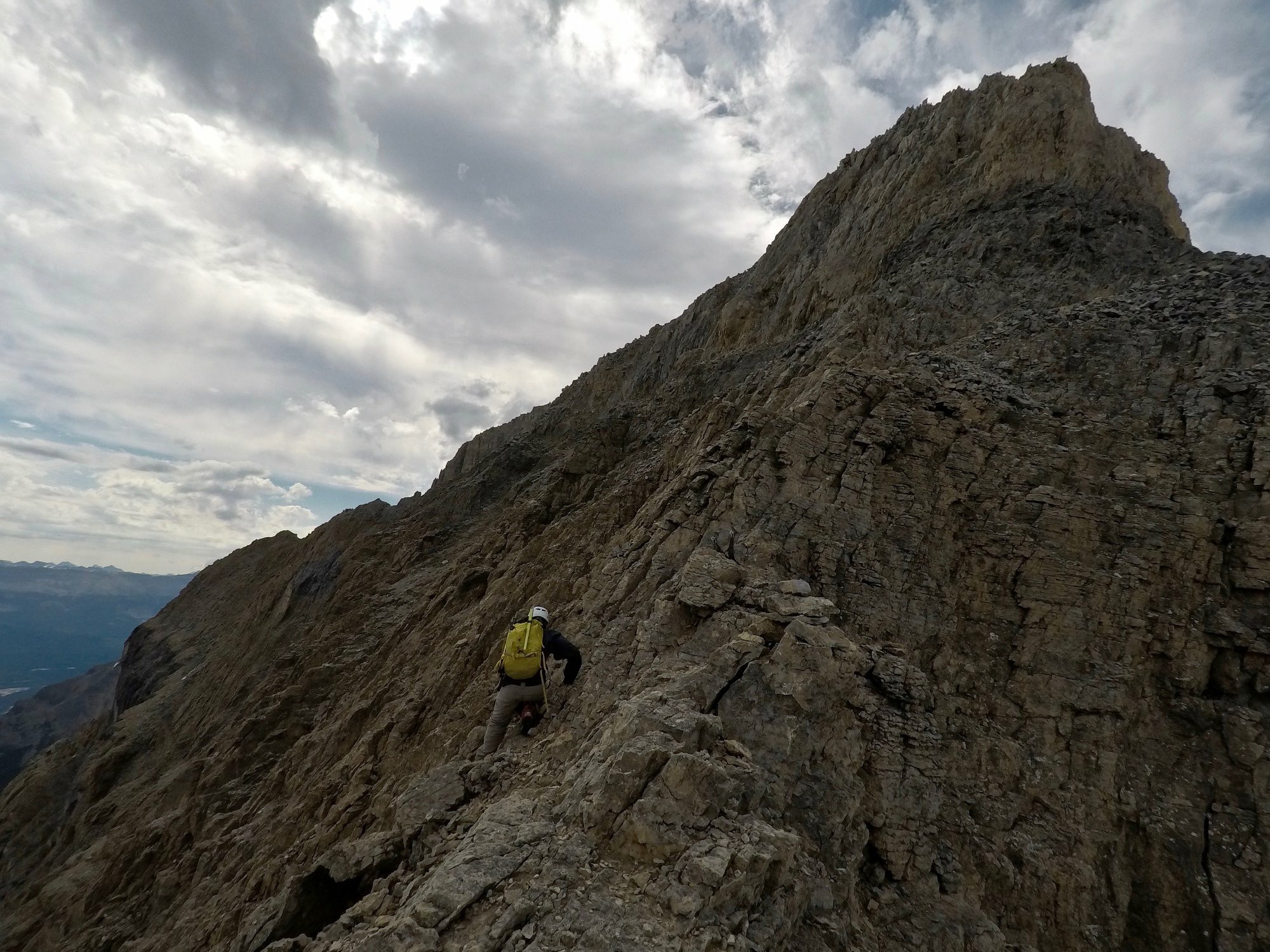
^ Difficult scrambling up Mount Whyte in 2018. Photo courtesy of Scott Haggarty.
Source Materials – whenever possible, I try to include our prime beta source(s) within the individual trip reports. As time goes on, our resources for trip planning expand, and the following list is not exhaustive but rather highlights our go-to sources of scrambling information:
Alan Kane (2016) Scrambles in the Canadian Rockies 3rd Edition
Andrew Nugara (2017) More Scrambles in the Canadian Rockies 3rd Edition
David P. Jones (2012) Rogers Pass Alpine Guide
Stefanie Mclellan & Corinna Strauss (2022) Hikes around the Columbia Valley
Bill Corbett (2016) The 11,000ers of the Canadian Rockies
Steven Song’s Peak Bagging Journey – stevensong.com
Vern Dewit’s Explor8ion – explor8ion.com
Bob Spirko’s blog – bobspirko.ca
Josee’s and Fabrice’s scrambling blog – goldenscrambles.ca
 Steep Sheep