
Hope everyone is staying safe and healthy during these uncertain times. With not much else on the go, I’ve got ample time on my hands and have decided to look back on some past scrambling ascents where the summit was not quite reached. This is a two-part post looking at the various reasons – for better or worse – that have lead to the old turn around. Part 1 offers a few examples of peaks I have yet to finish… and perhaps would like to one day revisit. Turn around heights are estimates.
1. Mount Stephen, Yoho National Park. August 2nd, 2016. Turned back at 3100m
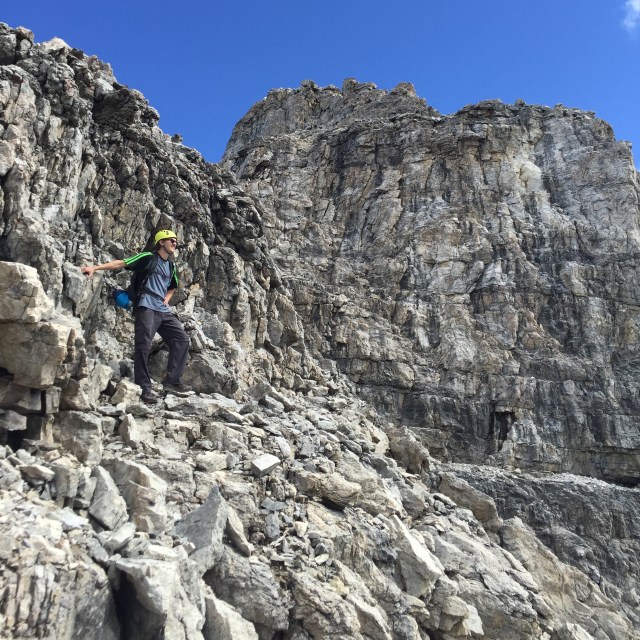
Ah, Mount Stephen. This is an iconic benchmark in the scrambling community as a serious effort both in stamina and in technicality. Having done a few spicy adventures already in that summer, I eagerly teamed up with Ben and we gave it a solid effort.
We had enjoyed the scramble up until this point, and once we hit the wall (see page 440 of Kane’s 2016 edition of Scrambles) we literally hit our wall. We could loosely see a way up but were well aware that the final 100m vertical is the most challenging part of the route. After half an hour of considering our next move we decided to back-off as neither of us felt comfortable down climbing the section seen in the photo above, as there is a 1900m sheer drop should you misplace a step. Coincidentally, the moment we returned to street level in Field, our decision to turn back when we did was applauded with a monstrous clap of thunder.
2. Mount Athabasca. August 2nd 2017. Turned back around 3380m
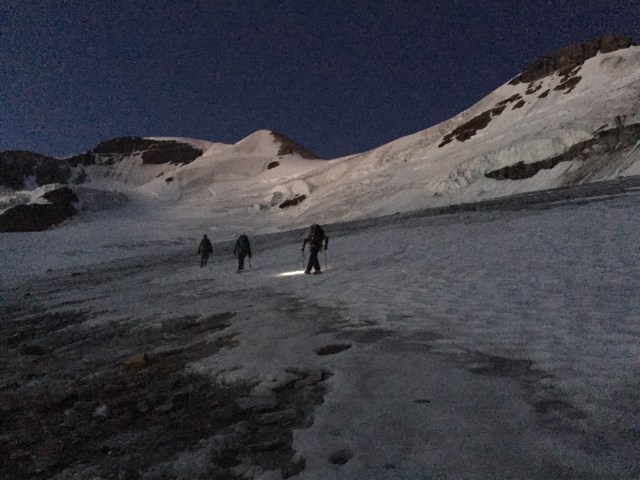
This one had a very promising start in that everyone involved committed to an alpine start and midnight departure from Lake Louise – which meant virtually no sleep going into the day. Conditions were near perfect in terms of weather and ice surface, the crevasses exposed and easily avoidable, and plenty of other alpinists around in case of an emergency.
So, what on earth went wrong? Short version is a communication error that lead to a lot of unnecessary waiting around, which further resulted in only two team members summiting. By the time everyone was regrouped and the confusion sorted, it was too late in the day for any further summit bids. Frustrated by the error, there were some heated exchanges on our way back to the carpark that afternoon.
3. Killarney’s La Cloche Silhouette Loop. Jan 29-30th, 2018 – Turned back at 17km
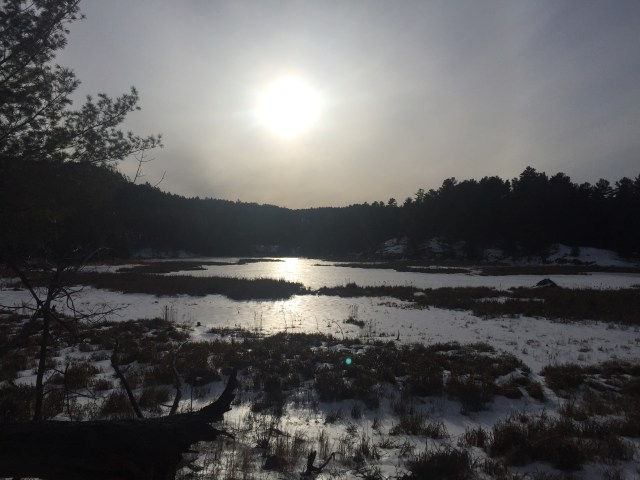
We had pretty big ambitions of completing the rugged 78km loop in late January. The trip was somewhat successful in that we did end up with a multi-day winter camping trip, the catch being we didn’t cover as much of the trail as anticipated. While 17km / 78km seems laughable, the trail takes on a whole new character when encased in ice, and even with turning back we still ended up trekking +34km.
Plummeting temperatures during the first and only overnight of the trip resulted in an early turn around. Forecasting models predicted -18C as the coldest night in the planned 4 day trip… -18C however ended up being the daytime high. It dropped towards -28C that night, which our gear was not rated for. Adding insult to injury, my water canteen did not seal properly due to the brim freezing that night, resulting in almost 2L worth of water seeping out across my tent floor and freezing most of my gear in solid ice. Having said all that, it was a memorable trip and eventually I will return to tackle the loop in winter once more!
4. Mount Sheol. September 26th, 2018. Turned back at 2740m.


This was a tricky turn-back decision in that the summit was visually within our grasp, and vertically speaking we only had to gain another 35m to top-out. Plus, it was our last Canadian Rockies ascent of the 2018 season. Winter arrived particularly early that year in the alpine, and we had chanced Mount Sheol knowing that we might not get the summit.
The deciding factor: a thick layer of snow blanketing the final ridge across to the summit. It was tempting to chance it, very tempting. Scott, whom is a seasoned split-boarder, was sketched out by the snow quality – and if Scott finds a patch of snow to be sketchy – you yourself best be sketched out too! Looking back at the photos from this trip, the ominous darkening clouds likely contributing to that turn around decision.
5. Mount Yukness. August 23rd 2018. Turned back within 75m of SW Summit
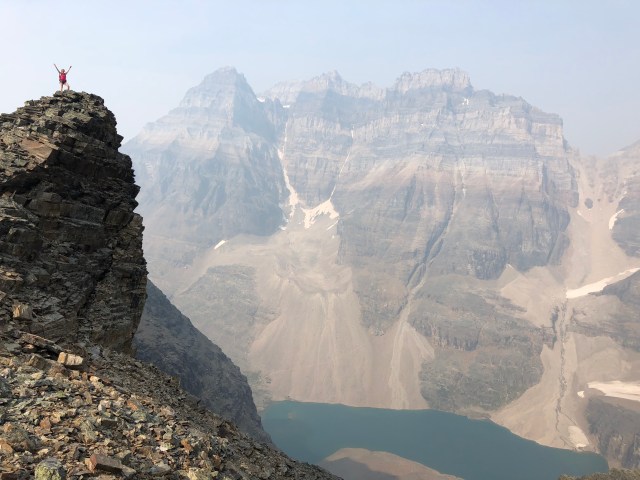
While not necessarily a difficult scramble per-se, I disagree with the level of easiness Kane (2016) used to categorize this route. Albeit, smokey conditions were a factor, we found there was more route finding involved than expected, and found the route to the Southwest summit to be far more exposed than what was is suggested in Scrambles (2016). Almost teetering onto the cusp of difficult scrambling.
All-in-all this proved to be too much for Bri, and I admittedly did not feel overly confident on finishing the summit as a solo ascent. If referring to the route photo on page 358 from Kane’s (2016) book, there is a brief yet steep gully connecting to the summit ridge. I believe we turned back at the base of that gully, where the ledges become increasingly more exposed and rock increasingly more rotten.
Though we did turn away from the true summit, we still consider this a successful trip having gained more elevation than one would have at the north summit. Given the difficulty of accessing the Lake O’Hara area, and offerings of other peaks, I doubt we will be trying this one again.
 Steep Sheep